Showing posts with label Articles on Technical and Strategic Development. Show all posts

Saturday, June 14, 2014

"High Utility" Firearms Drill Training

Anyone who has been around tactical community for any length of time, be it as an operator, trainer, and/or leader, is likely familiar with the Viking Tactics (VTAC) 1-5 Drill.  Sergeant Major (ret) Kyle Lamb, US Army Special Operations combat veteran, author of “Green Eyes & Black Rifles: The Warrior’s Guide to the Combat Carbine”, and president and founder of Viking Tactics breaks down the essentials of the VTAC 1-5 drill in this video.

In this article, I will refer to this version of the VTAC 1-5 drill as the basic/base drill.

Industry innovators such as Travis Haley underscore that there is a difference between rote drill training, and understanding/developing drills at a “deeper level”.  Travis Haley, US Marine Corps Force Reconnaissance combat veteran, former CEO of Magpul Industries Corporation, and president and founder of Haley Strategic Partners, LLC demonstrates an advanced application of the VTAC 1-5 drill in this video. 

The purpose of this article is to highlight that trainers/operators/practitioners need to understand drill training at a deeper level in order to ensure a “best fit” approach to training using the drills which facilitate optimal skill development within the constraints of financial budgets and time. At the time of this article, I have over 15 years of experience as a trainer in the tactical community.  Although the core curriculum I use is CSAT based, I do use and teach the VTAC 1-5 Drill as one of the training platforms for myself and my fellow students/operators.

Three fundamental truths that I believe trainers/operators/leaders need to accept when looking more deeply into drill training are:

·         No single drill will provide repetition of all the various skills sets required in any given operational environment;
·         Some of the various skill sets needed for the operational environment are trained in direct opposition to each other; and
·         Optimal learning does not occur unless trainers/operators/practitioners understand the inherent assumptions contained within a drill’s practice method.

To illustrate these points, let’s again use the base VTAC 1-5 Drill as an example.  In the first video, we see the drill executed (15 rounds total on 3 targets) in under 3 seconds.  Training the drill using this method allows practice of many critical technical & tactical skills to include: optimizing the manner in which the weapon is “welded” to the body, optimizing the manner in which the shooter traverses from target to target, & optimizing the manipulation of the trigger.  However, in order to optimize the cadence of the drill, shooters maintain their finger-to-trigger contact while traversing target to target.  When the actions needed to perform the drill at the cadence demonstrated are extrapolated into the application environment, an operator moving a weapon from one threat to another with his/her finger on the trigger (potentially across innocent/friendly persons) would be violating most tactical SOP’s.  What SOP’s you ask? Most shooters who learn the “4 Firearm Safety Rules” learn that their finger is to be “off the trigger until their muzzle is on the target”; cases such as Medina v. City of Chicago show that our legal system considers the placement of the finger on the trigger when not shooting to be “willful and wanton” conduct.  And since we perform in the manner that we practice, practicing with our finger on the trigger will increase the likelihood that we will perform that way in the operational environment.

Does that mean that we should drop this version of the VTAC 1-5 drill from our training curriculum? Absolutely not! It simply means that trainers/operators/practitioners should understand that when they practice the drill in this manner, they are training the optimization of aspects such as weapon “weld”, traversing from target to target, manipulation of the trigger, etc.

It is incumbent upon trainers and leaders to develop utility in their training drills that are consistent with their application environments. These “higher utility/application oriented” drill variants should be added into the curriculum.  The variants should include the physical skills performance expectations that we seek during application: for instance, if we expect the shooter’s finger to be out of the trigger during movement from one target to the next, we have to incorporate that into the drill’s “language/expectations”.  If we expect a follow through sight picture on targets that have been engaged, we likewise have to set that into the drill’s “language/expectations”.

In this final video, we look at a "utility/application oriented" variation of the VTAC 1-5 drill.  In this version, some of the individual skills being trained include finger off the trigger while traversing from target to target, follow through sight picture prior to traversing from target to target, and a speed load during the drill execution (intentionally set up by using a partially filled magazine).  Since we wanted to incorporate the rifle reload skill, we set the drill distance up along the method described in the previous video by Travis Haley.  This is because of the tactical preference to reload the rifle at longer distances while tending to transition to the pistol at closer distances.  Even under 10 seconds total time, the trigger manipulation in the drill is less than optimal when compared to the base drill.  So while this variation builds utility, for a shooter to improve trigger manipulation skills, the original VTAC 1-5 drill should be used.  So here we see two inherent opposite methods needed to train two necessary skills for the operational environment: optimal trigger manipulation when engaging and finger off the trigger when traversing, as examples.

By constantly returning to the basic drills, extrapolating the current needs of the operational environment, and incorporating them into utility-oriented drills, we build a feedback loop that deepens our understanding and continually builds our skills.

Read more about building utility.

Sunday, January 26, 2014

The Truth About "Self-Defense" Workshops…

I have been training people in physical skills since I was 15 years old – at the time of this writing, that’s 25 years of teaching experience.  Some of the people whom I am privileged to teach are professionals who require physical skills as part of their profession – military and/or law enforcement personnel generally.  Others are physical skills/martial arts students who have a professional approach towards their own training.

This month, The Midwest Academy provided a 120 minute “Women’s Self-Defense Workshop” at a fundraising event; we wish to pass along some of the general lessons learned from that workshop. While conducting research into current “Women’s Self-Defense workshops”, we looked at many of the already existing training platforms and discovered they generally had the following aspects in common:
  • They advocate that a woman strike an assailant’s “eyes, throat, & groin”;
  • They advocate the use of elbows, knees, & head butting; and
  • They presume a single male attacker as the only assailant.
In order to validate the workshop training, many of these programs dress the mock assailant in a padded suit and basically allow him one attack after which time he remains stationary and the student uses him as a “punching bag”.  A significant number of these programs also have some "gimmick" that the course is based upon - for example, the 'high heeled shoe' as a weapon.


This is excellent marketing in that it allows people to leave with a sense that they have some solutions with which to defend themselves, but is that really the case?  From an anatomical perspective, while these are "soft targets", the “eyes, throat, & groin” are the most instinctively & reflexively guarded parts of the human anatomy.  In addition, in order to directly strike these targets, the defender places herself directly in front of the attacker - a position that the Academy refers to as “work-space to work-space alignment” – in this alignment, the defender has no advantages and the position is most favorable to the larger, stronger, & more aggressive person.  In addition, the defender’s eyes, throat, & groin are as equally vulnerable as the attacker’s.  Finally, as if that’s not enough, the strategy advocated by these programs requires the defender to be at a distance close enough to perform an elbow strike, knee strike, or head butt (which, if incorrectly performed, can cause the defender to lose consciousness).  And while those anatomical weapons are formidable by all accounts, even trained fighters do not stand and strike at that distance while in that position (work-space to work-space alignment).  The formulaic approach clearly has marketing advantages, however, it likewise lacks integrity with regard to the welfare of the student.   

The Truth…

Almost all of our attendees were likely surprised during the workshop introduction where we simply stated that they would not leave the workshop with any applicable skills.  This is not a reflection on our curriculum, teaching ability, nor any such factor – the statement is based on an understanding of how humans create utility with regard to physical skills – utility is the ability of the skill performer to effectively perform the skill in the environment and under the conditions for which the skill is designed.  Utility is the process of moving from a knowledge set – knowing what to do given a set of stimuli – to a skill set – doing what you know given a set of stimuli.  It is often described as the path from unconscious incompetence to unconscious competence - we have previously made the skill building analogy with how one learns to drive a car.  How long does that take? There are a number of factors some of which include: the existing skills of the learner, the complexity of the skill being learned, the methodology being used to teach the skill, the frequency in which the skill is practiced, & the intensity of the training. 

The two points, however, to always keep in mind when learning a physical skill are:

·         No physical skill can be internalized (unconscious competence) in 2 hours, 2 weeks, 2 months, or probably even 2 years; and
·         There is a direct relationship between practice and skill development – the more you practice (assuming correct practice), the better you will get.

Anyone that tells you otherwise is doing you a disservice.

It is not the Academy's position that there is truly a difference between “men’s self defense” and “women’s self defense”; there may be a case for beginning the training process at different points as, based on empirical data, men & women tend to be attacked for different reasons/purposes and thus are attacked differently.  Most attacks on women are initiated with some type of control as most women are attacked by attackers that wish to control them.  Most attacks on men are initiated with some type of strike or weapon since the objective is to remove their ability to resist the attack.  However, eventually, regardless of gender, a quality training program must address all categories of attacks.

Therefore during this workshop we focused on a principle based solution that achieved the following objectives:

  • Moved the attackers control further away from the attacker’s body core (thereby weakening him) and closer to the defender’s body core (thereby creating a relative leverage advantage in favor of the defender);
  • Forced the attacker to maintain the control with “limb strength” while allowing the defender to release the control with “core strength” (creating a relative strength advantage in favor of the defender);
  • Moved the defender into a “flank” position on the attacker making it more difficult for the attacker to continue attacking and easier for the defender to strike, control, or escape (creating both a relative position & speed advantage for the defender).

 We used a few variations of the same attack, but the above principles and movements are basic solutions to almost any control from any position.


A final thought on the 120 minute workshop was that by using a principle based approach, students were leveraging Hick’s Law to their advantage.  Hick’s Law states that the greater the number of options, the greater the reaction time needed to employ any of them.  Since students essentially learned one principle, their reactions will eventually be very efficient.  We say “eventually” since it still requires practice to internalize the mechanics of this principle.


The Midwest Academy's goal in providing workshops is to educate the public on the role of awareness in personal protection. With regard to physical skills, it is our objective to provide a realistic overview of what a usable skill set is as well as to provide the foundation to recognize what utility-oriented training looks like.  

For information on this or other programs offered by The Midwest Academy, please visit our website.

Saturday, January 4, 2014

Pad/Focus Mitt Drill Challenge – "Tactical" Striking

In December 2012, I was one of a few expert guests on a radio talk show discussing “tactical training”.  The show’s host asked for a definition of “tactical training” (the show’s topic related to firearms training specifically and thus the answer provided was in terms of firearm’s mechanics and application - however the concept applies more generally to all types of armed and unarmed combat sciences); while the answer I provided of applying the basics which were mastered in a ‘flat’ environment (without all the dynamics of the environment of application) in the ‘application’ environment may not have understood by the show’s host, it was agreed upon my fellow guest “tactical firearm’s training” experts.  I found myself at a slight loss as to why the show's host, the president of a firearms training company himself, did not understand what, to me, was a simple response - however as I thought more about it, I began to realize that fundamentals practiced outside the "application environment" are conducive for repetition, but not for building problem solving skills.  I also realized that most training is repetition oriented, but not problem solving in nature - so even long standing experts may not have a good understanding of problem solving if all they have focused their training core on is repetitions. And ultimately "tactics" are about problem solving tense, uncertain, and rapidly evolving problem sets.

For the past several years, the Midwest Academy has taken our TAB (Tactically Applied Basics) Module on the road to various training venues – the training gap that the program addresses is simple, but extremely relevant to the “application environment” and thus what makes it a “tactical” program.  That said, before we present you with our challenge to add to your training regimen, let us offer you a succinct look at the “why’s” involved:


"The Why's"


Most combatives (armed, unarmed, & even firearm-based) are taught in straight line relationships.  Some of the reasons for that are:
  •  It is easy to manage a group of students when everyone is lined up the same way; 
  •  It also allows for a safe training environment; and 
  •  It maximizes a training space.  

These straight line relationships are what we at the Midwest Academy define as “0% basics” – they are flat – there are no deviation dynamics such as lateral movement, elevation changes, changes in distance, etc.,  between the threat and the defender.  The practice of “0% basics” is useful for the development and refining of mechanics that are fundamental to whatever specific combative technique one is studying.  For example, in a fistic strike, the fundamentals likely should include the shift of the weight forward and down combined with the alignment of the hip, shoulder, elbow, and weapon surface to the target’s contact point.  For a firearm, fundamental practice may include establishing a natural point of aim, proper grip, proper sight alignment, and correct trigger press.  Both of these examples are the combat science equivalent of learning to drive in the store parking lot after the store has closed and everyone has gone home.  It is a needed building block that facilitates fundamental skill development, however until one takes the vehicle to the “application environment”, the skills needed for driving on a highway with merging and lane changing remains an elusive theory.

"0% Basics" or 'flat' fundamentals
The TAB module draws from the teaching perspectives of the MOUT (Military Operations on Urban Terrain) and SWAT (Special Weapons and Tactics) environments, both of which initially focus on understanding the geometric angles created by various doorways, room designs, building architecture, etc, and using that knowledge as a force multiplier in the action-reaction model (OODA Loop); in the case of the TAB Module, it is applied to the “tool kit” of the unarmed combatant (the base layer of the layered offense theory below).  

This approach is dovetailed from the layered offense training theory advocated by CSAT Founder and SOFD/D (“Delta Force”) MSG Paul Howe (ret) which I first learned as a young soldier and later refined under MSG Howe’s instruction; the layered offense training theory states that the system of fighting with a rifle, pistol, edged/impact weapon, or empty hand should be fairly uniform such that transitions in either direction are seamless, adjustments from force option to force option are minimal, and training for each force option is complimentary to the others.  Using this as the base development perspective for the presentation of the TAB Module allowed myself and the other Midwest Academy instructors to leverage our military and law enforcement special operations backgrounds not to “bring Special Ops to the training floor”, but rather to take the “training floor into the application environment”.  The rationale for developing the TAB Module is based on our collective experience which confirms that the action-reaction model, which integrates distance, angle, initiative, etc, works against the defender unless the defender learns how to maximize the geometry of the urban environment.

A"corner fed doorway" - the black ring that has been added shows the area that the waiting attacker can immediately control placing the defender at reactive disadvantage if he does not understand how to maximize geometric angles.

 This topic is both too broad and too deep to present in this type of a format, however, if you have read this far, I think you get the point of the “why’s”, so on to the “how’s”:

"The How's"

Being introduced to the geometry of the application environment removes some of the “neatness” associated traditional “0% basics” in the “flat” environment.  As combat athletes, we normally train these basics on a fixed position target (such as a heavy bag) or with a partner (such as with pad drills); in either case, we know we are performing the basic, so we tend to pre-align in a manner that puts us “center on” the target.  Once you have a solid understanding of your basics at this level (we suggest at least conscious competence), we encourage you to take the following challenge:


Instead of beginning “center on” your target, place the target where you would have moved to evade the basic you are working on (see above diagram).  In general, the targets would be outside the left and right planes of your shoulders.  From here you will find that many of you will get tuned into the skill set of smoothly shifting weight since you are required to initiate lateral movement to put yourself “center on” the target prior to executing your basic.  There are two basic methods of shifting and stepping that you will learn by doing these “5% adjustments”:
  • Method 1 – the target is on the outside of the direction of rotation of the lead leg (for example, defender is left foot lead and the target is to the outside of the defenders left shoulder) – the defender will need to un-weight the lead leg, move it laterally to the outside (and forward if distance requires) with the rear leg moving laterally to the inside; or
  • Method 2 – the target is on the inside of the direction of rotation of the lead leg (for example, defender is left foot forward and the target is to the outside of the defenders right shoulder) – the defender will need to un-weight the rear leg, move it laterally to the outside (and forward if distance requires) with the lead leg moving laterally to the inside. 

Writing is not always conducive to describing human motion, however, students at the Midwest Academy and other students that have been introduced to the TAB Module incorporate these types of “fundamental” evolutions to their practice with results that increase their agility, adaptability, and the ultimate utility of their skill sets.  If you train simply to "get in shape" with no regard for the application of combatives, the added lateral movement will give you a level of conditioning that few other training drills can provide.  Finally, the understanding you gain by doing these drills will also decrease training/application injuries and increase the sustainability of your training by reducing "over extension" and working "outside your work-space" inefficiencies. 


We invite you to add these drills to your practice and let us know what you think.  If you have any questions on how to incorporate this into your own training or wish to learn more about ours, please contact us at (630) 836-3600 or through our website.

Monday, December 30, 2013

2014: "Next Steps" Firearms Training at the Midwest Academy

2013 Midwest Academy Firearms Program in Review

In 2013, the Academy began teaching its CSAT (Combat Shooting & Tactics) based firearms program to qualified civilians.  CSAT is a system developed by retired Army Special Operations Force/DELTA MSG Paul Howe who served as a team leader and trainer in the Army’s most elite units; Paul is now heads CSAT, his own training company.  CSAT can be researched here.  For over a decade, David Hakim, a law enforcement Special Operations Team Leader and Trainer to multiple teams and also the Academy’s Director, has been teaching this system to Law Enforcement Special Operations Teams. 

The Academy’s firearms training exceeded student's expectations by emphasizing the fundamentals of shooting (pistol, rifle, or both) and applying these fundamentals tactically.  The student roster was diverse – men and women, some of whom had little experience to current and veteran law enforcement and military special operations personnel.  A number of students repeated the course for the experience and drill repetitions.


In Illinois, as we enter 2014, the state’s Concealed Carry Weapons (CCW) program takes its first steps forward.  The Academy is a strong supporter of the Second Amendment and the responsible armed citizen.  That said we have opted to stay out of the CCW training environment for the following primary reason:

Integrity – all of the programs at the Academy are taught by instructors who have high levels of personal and professional integrity combined with skills that are rooted both in extensive experience and training.  We have chosen not to lower our standards to that of the state's qualification: of the 16 hours of CCW training required by the state, the actual skill set of “shooting” consists of 30 rounds fired of which only 21 have to be “hits”.  Since the shooting portion is un-timed, if it even took as much as 1 minute to fire each round, the 30 minute range portion would still only be 3.125% of the total training hours. The accuracy required under un-timed, non-stressful shooting is only 70% to quality. The remainder of the state mandated hours includes instruction on topics such as liability, use of force, transportation of firearms in “gun free zone”, and the like topics. 


As the Director of the Academy’s Firearms Program, while I do have an experience base that includes roots as a military combat veteran and a veteran law enforcement special operations team leader; while my daily experience includes carrying a weapon everyday for approximately two decades, it is outside my experience base to opine on the ambiguities and statutory contradictions contained within the current Illinois Public Act 098-0063 (Conceal Carry Statute).  Furthermore it is not in the long term interest of the Academy's students to train to the sub-par standard of the state's program; we believe without additional training and dedicated practice, this standard will be counterproductive in the gravest extreme (see our previous article discussing High Utility Combatives).

We have, however, chosen to remain in our area of expertise – in this case the tactical application of firearms – which we know at a deeper level, and teach, using a superior-results-oriented method, than any other locally available teaching group (particularly those groups attempting to be all things to all people). By continuing to focus on developing the optimal skill sets for our students, we believe that we can address the utility gaps inherent in the state's training standards as well as those created by opportunistic instructors that view the CCW training as another "money grabbing" opportunity.

The Academy encourages citizens of Illinois to seek out and obtain their CCW certification/license, however, cautions to be wary of instructors who stake their claims solely on NRA certifications, reserve/auxiliary law enforcement credentials (even many active law enforcement officers elect not to carry a weapon off duty and, thereby bring into question the integrity of their “experience” on the matter), credentials that state that they train law enforcement and/or military personnel, and anyone that politicizes self-defense training related to CCW (enough said on that sub-point).  We offer the following article as a guideline for finding an instructor: Finding Qualified Instructors

2014 Midwest Academy Firearms Program Preview

In 2014, the Academy will continue to offer our CSAT TPO (Tactical Pistol Operator - Video Drill Demo) and TRO (Tactical Rifle Operator) courses determined by logistics, but will also introduce a tactical firearms program that meets bi-monthly at the Academy and is designed to be a “next steps” program.  It is the “next step” to take after qualifying for a CCW license and, in the Academy’s tradition, solicits the serious student of the firearm as opposed to “wanna-be’s with a gun license”.  The real world experience that Academy instructors’ possess continually hones our curriculum and is without peer in the region.  However when combined with the bi-monthly format of the training - training which includes quality repetition, in-depth tactical study, and regular high-frequency practice sessions - produces unparalleled tactical competency.

Some of the topics covered include: the best carry methods for a CCW lifestyle, the most efficient and effective methods for presenting and employing a firearm, weapon ready postures, tactical scanning methods, tactical decision making, movement with a weapon, the effective use of cover and concealment, tactical geometric angles, immediate “tactical casualty care” (for yourself or another), identification to law enforcement, and case study analysis on significant shooting incidents.  All of the Academy’s firearms courses are based on the CSAT methodology and, as such, the principles are conducive to both on (live fire) and off (dry fire) range practice sessions.  Like all Academy programs, the “next step” firearms program is both cost and time effective. It requires, however, an investment of effort and attention on the part of the students. 

Qualified students will possess a valid Illinois FOID and an Illinois CCW, or another state’s equivalent, or be Academy students screened through our in-house process.  All Academy students, firearms students included, must possess a positive can-do attitude and be dedicated to improvement.

For more information or to apply for training to the Academy, please contact us at either (630) 836-3600 or Visit Our Website.

Tuesday, January 1, 2013

"High Utility" Firearm & Combatives Skill Development

“High Utility” Firearm & Combatives Skill Development


(Qualification Processes versus Holistic Skill Development Systems)

This article is the result of many conversations that I have had with people following a recent 2012 court decision by the 7th US Circuit Court of Appeals. The court returned a finding that Illinois’ statewide ban on concealed carry (of a firearm) was unconstitutional. The court’s interpretation of the Second Amendment of the Bill of Rights in the United States Constitution, with regard to this case, is that American citizens have the right to keep and bear a firearm inside as well as outside the home for purpose of self-defense. Judge Richard Posner is quoted as stating, “A Chicagoan is a good deal more likely to be attacked on a sidewalk in a rough neighborhood than in his apartment on the 35th floor of the Park Tower”. Illinois was given roughly 180 days to develop some provision for their citizens to now legally exercise this Constitutional right.

Numerous individuals and organizations contacted me following the court’s decision to discuss various topics related to CCW (the concealed carry of a firearm); conversations varied from simple inquiries as to licensing availability through the Midwest Academy, to more complex concerns such as the depth and quality of any yet-to-be-developed state curriculum. Most of these individuals and organizations that contacted the Academy/me did so due to the experience base here: few organizations are able to speak professionally from the perspective of military and law enforcement special operations veterans that have been an operators, leaders, and trainers in those venues. Of the few individuals that fall into this category, few also have nearly two decades of daily conceal carry, plain clothes interventions, and critical incident resolution experience. The preceding is not an attempt to impress the reader, but to impress upon the reader that the following is an experienced-based synopsis that has also been vetted in the “real-world”; it is not simply theory, conjecture, or opinion. What follows is a discussion addressing the five core components of “high utility” skill development as related to combatives: Skill Performance, Scanning & Decision Making, Tactical Integration, Medical Skills, and Combat Mindset.


Skill Performance (Conscious vs. Unconscious Skill Competencies)

Training that licenses one to do something usually involves some process of qualification; however, in order to avoid the “minimum standards trap”, one must first examine if a “qualification” ensures that someone is “qualified” to perform the action in the venue of its likely application and under realistic conditions associated with the action’s utility. In other words, can a “qualification” incorporate the critical elements of the real world? The “minimum standards trap” is a recognition that many qualifications are designed, instead, to absolve an instructor/organization from potential liability. That is quite opposite to it functioning as a measurement of the degree of utility that an individual can apply a particular skill set with. In the field of combatives, regardless of the platform (rifle, pistol, impact tool, edged tool, or empty handed), the dynamics and variables involved defy the development of “unconscious competence” (for information on learning theory as applied to physical skill sets, see our previous 2010 article on Integrated Training ) in an 8, 16, 32, or even 40 hour format. There is simply not enough time in those formats to perform enough correct repetitions, at an appropriate level of intensity, in order to build “unconscious competence”. Most “qualifications”, however, are structured around fixed time constraints such as those described.

In fact, it has been my experience in nearly 3 decades of combatives training, few people develop “unconscious competence” in physical skill sets due to the sheer time commitment required to perform the volume of repetitions needed. In addition, the magnitude of mental exertion required to perform each repetition correctly is beyond most exponent’s level of personal discipline; that is particularly true if they are “self-coached”. “Unconscious competence”, additionally, is not and end point; it is a continual process requiring regularly applied “maintenance repetitions” in order to keep the skill set from degrading or perishing altogether.

Does that mean that a skill that is not internalized at the level of “unconscious competence” cannot be used? Absolutely not. In fact most physical skill sets, in my experience, are employed at varying degrees of “conscious competence”. That means that some level of “thinking” through the “how” of some or all parts of “the action” occurs while executing the skill. What am I making that assertion on? Simply this: vivid analytical recollection of the specific mechanical aspects of a physical skill following its application indicate a conscious thought processes driving the skill set; hence the ability to recall it vividly. Conversely skills performed at a level of “unconscious competence” tend to leave only an intuitive sense that some parts of the skill set were applied. When combined with a practitioner’s knowledge of what mechanics “should have occurred”, that intuition is confirmed by the practitioner’s “general feeling/state of awareness” that the sequential mechanics did occur, but without specific recollection to “doing them” during the incident. Task specific action without cognition indicates that an “unconscious mind” is driving the skill set. As an analogy for the latter scenario, one can think of locking a door that one locks every day. Since the daily locking of the door is routine, it often occurs while thinking about something else. As a result, after a few minutes, one begins wondering if one locked the door or if the “memory” of locking the door was from a previous ‘repetition’ of locking that door. Since the locking of that door is habitual, most of the action is driven unconsciously thereby making conscious recollection of a particular ‘locking repetition’ difficult.

Let me offer a comparative analogy to help explain the above and demonstrate the “higher utility” that “unconscious competence” is capable of producing: think back for a moment to the earliest recollections that you have of driving an automobile. At that time, driving required all of your conscious energy. Even then the mechanics of the skill were not always smooth or correct as evidenced by the white knuckles and held breath on the part of your driving instructor (maybe on your own part as well). As you gained time (and repetitions) behind the wheel, complex aspects of driving become more familiar. For example, as a light turned from green to yellow to red, you applied the correct amount of pressure to the brake to gradually slow the vehicle in the appropriate amount of distance. By contrast, if some emergency that required stopping quickly presented itself, you applied the same braking action, but used different dynamics in order to effect deceleration in the distance dictated by the emergency. If you have been driving for any significant length of time, you may have had this experience at least once (or, maybe, more regularly): you drive a familiar route (such as between home and work, for example) and find yourself arriving at your destination without any significant recollection of the specifics of that particular trip. You may actually recall something else you were thinking about consciously, other than driving, during the trip: a phone conversation, planning for something you need to do, or evaluating something that happened, as examples. You may have no specific recollection applying the brake to stop at a given stop sign along the route, but if you press yourself to “remember”, having ‘practitioner’s knowledge’ that a given stop sign exists at a specific point in your route, you likely have in “intuitive recollection that is confirmed by general feeling/state of awareness” that you stopped for it. You would not, however, be able to mark on the pavement the specific spot where you began to apply brake pressure to decelerate the vehicle. That type of detail was outside your sphere of conscious awareness. One would say that a person driving at this level has “internalized” the mechanics of driving at a level of “unconscious competence”.

So what that all that mean? Driving at a level of “unconscious competence” does not mean that you are a “bad” or “distracted” driver. It means that, as a result of internalizing the mechanics of driving at a level of “unconscious competence”, the driving skill set has “high utility”. It has “high utility” in the sense that the foundational mechanics can spontaneously produce correct action without conscious thought. Take for example driving through an unfamiliar area while your conscious mind is focused on locating a specific address or street - suddenly a small child darts out between the front and rear bumpers of two cars parked on the side of the street that you are driving on. Without specific conscious thought directing the response, you adjust the speed and direction of your vehicle to either drive around the child, if he is close to the cars, or stop your vehicle, if he is more towards the street. This is not a “trained response” since you have never been down this street, under these lighting conditions, with these road conditions, etc., and practiced this evasive maneuver for these specific variables before. All those variables, as well as the totality of distance, speed, and directions were intuitively (without the conscious thought process) accounted for. The driving mechanics that exist at an “unconscious level” produced exactly the appropriate set of actions needed for this specific and dynamically occurring situation; the action co-developed with the situation as opposed to an “action-reaction” response. Therefore, since the action was co-developed, it developed spontaneously; the child did not reach an end point of movement that your mind then developed a response action to. As the child was moving, the driving inputs were being adjusted.

By comparison, newer drivers tend not to have their driving mechanics completely internalized. Thus, their driving skill set exists at some degree of “conscious competence”. Their skill set produces desired outcomes (safe driving) as long as the variables of a given condition do not change so dynamically that their conscious mind is not able to analyze the changes, identify the appropriate response, and translate the intellectualized response into the correct physical actions. When variables change too rapidly for the conscious mind adapt through analysis, we can correctly say that their OODA loop (the ‘Observe, Orient, Decide, Act’ model of perception, decision, and action) was compromised/overwhelmed. The data that was “Observed” and being “Oriented” to changed prior to a “Decision” being made (in a timely manner) and “Acted” on. To illustrate this, think of the ‘at fault’ driver following a car accident. This driver usually knows what could have been done to avoid the accident (such as slow down, speed up, turn, or some combination of those inputs) in retrospect, but in the moment, the driver was not able to create the process that would lead to the desired outcome (not having the accident). Does this mean that only inexperienced drivers have accidents? Again, not at all. However, insurance companies that profit through accurate risk analysis view less experienced drivers as being at greater risk of having an accident as compared to more experienced drivers. As a result, they charge greater premiums to offset the increased risk.

If both experienced and inexperienced drivers have passed the same “qualification” standards to drive, why would a statistical risk analysis differentiate the two groups? The less experienced driver with a new driver’s license has the same “qualifications” to drive a vehicle as the more experienced driver, however, the insurance company’s risk analysis shows that the less experienced driver is less “qualified” to drive safely than the more experienced driver. Even if the outcome of “safe driving” is produced by the less experienced driver, the insurance company still believes this driver to be higher risk because the “process” of driving is not internalized at a level of “unconscious competence”; the newer driver’s skill set has less “utility” than a more experienced driver in terms of producing the desired outcome (safe driving) in a dynamic environment. In our driving oriented culture, insurance companies typically lower risk premiums around 25 years of age – if the typical driver passes a “qualification” at age 16, the risk analysis shows that he/she is more “qualified” after almost a decade of regular repetitions.

Returning to the general topic of combatives, and specifically firearms, what mechanics does one seek to have “internalized” in order to create “high utility”? The short answer is all the mechanics related to the act/action of shooting. There are three general components to the action of shooting that all quality training programs identify and focus training on: the grip, the sight alignment, and the trigger press. Other factors such as posture, breath, etc are also trainable components of those three fundamentals – all of these should be internalized at a level of “unconscious competence”. The point of this article, however, is not to discuss “how” to shoot, but what core component skills must be developed to have a “high utility” shooting skill set. At a minimum, the mechanics of the Skill Performance (the grip, sight alignment, and trigger press) must be developed to a level of “unconscious competence” in order to create “high utility”.

I have spent a significant amount to time to demonstrate why “qualification” should not be equated with “high utility” skill development. My intent is not to discourage individuals from training programs that are “qualification” oriented, but to have them understand that a “qualification” is the beginning of a mastery process and not the end. Quality training provides avenues for further skill development beyond the “qualification”.

Scanning & Decision Making (“Thinkers before Shooters”)

Once the conscious mind has been freed of the need to “create” the mechanics of action (since “action” is now performed correctly and without conscious thought), the energy of the conscious mind can be directed into a skill set necessitating analysis: scanning and decision making. Efficient scanning and decision making are required to create “high utility” combative skills and, in my opinion, are one of the most underdeveloped areas related to most firearms training programs. Scanning and decision making are essentially two different, but interdependent, skill sets; as mentioned before, however, this is not an article on “how to”, but rather a synopsis of “what are” the skill sets make up the whole of “high utility”. Therefore, I will refer to the scanning and decision making skill sets by their interdependent outcome which we will call “discrimination”. “Discrimination” in this context refers to being able to fluidly and accurately decide if something/someone is either a “threat” or “no-threat”. It also includes a method of using one’s body movement and eyes so that no areas of “the battle-space” that are omitted from one’s awareness.

Good discrimination relies on the ability to gather and process data in a dynamic environment. At the Academy, we use the CSAT (Combat Shooting and Tactics) method of Tactical Scanning in order to gather this data. It is important that the mechanical aspects related to the “Skill Performance” of shooting be supportive of the mechanical aspects used in the tactical scanning process; when the mechanics in multiple skill components support one another, synergy between skill sets is produced. The mechanics Tactical Scanning facilitate gathering multiple layers of data regarding a potential threat/unknown individual in the “battle-space” so as to make accurate decisions. The “discrimination” process results from the interplay of scanning and decision making on the following levels:

• Whole Body – the initial scan of an individual should take in the whole body view. Depending on the distance of the individual being scanned and battle-space lighting conditions, the operator may need to use the “rod cells” (peripheral vision) or “cone cells” (“focused” vision) of his/her eyes to capture the whole body view in an instant. In addition, the operator’s weapon ready posture must be internalized in a way that it does not obstruct the whole person view, but can be readily presented if a threat is identified. That means a compressed high ready or “sul position” are the two preferred methods for a pistol and a low ready (muzzle below the belt line)preferred for a shoulder mounted weapon;

• Hand-Hand – distinctly seeing both hands is critical to identifying “threat” or “no-threat”; a gun may be in one hand, but the other may contain a badge, for example. If one or both hands is being concealed from view, that also provides threat indication data to the operator (as concealment is not a natural part of day-to-day action);

• Waistband – this is the area that a weapon can most readily be deployed from;

• Wingspan – the ‘lunge area’ of an individual may contain “threat” or “no-threat” data such as a pistol or machete, for example;

• Demeanor – does the person’s overall conduct seem to indicate “threat” or “no-threat”.

Since discrimination is a conscious and continual process in the battle-space, it becomes a factor in limiting the speed of movement – one cannot shoot faster than one can move and correctly discriminate (think). Developing a “high utility” shooting skill set is contingent upon having proficiency in scanning and decision making. Synergy results when the Tactical Scanning and Decision Making mechanics are smoothly and precisely dovetailed with mechanics of Skill Performance at a level of “unconscious competence”.

Tactical Integration (From the Range to Reality)

The next core component in developing a “high utility” shooting skill set is the tactical component. This component has had a significant volume written about it in the tactical community, however, this discussion can be facilitated by dividing tactics into “tool oriented tactics” and “movement oriented tactics”. “Tool oriented tactics” are the immediate action drills which have the purpose of keeping the tool useful during an engagement. Since these are actions intended to be performed during an engagement (when the weapon does not function correctly), these actions need to be internalized at a level of “unconscious competence” (along with the Skill Performance component) in order to create “high utility”. Some examples of these drills are ‘emergency/speed reloads’, ‘tactical reloads’, ‘multiple target transitions’, and ‘weapon transitions’. These drills are common to most firearm training programs.

As one begins to incorporate the core component of tactics into the whole of the shooting skill set, the quality of tactical training becomes imperative to consider; tactical training quality is often difficult to assess since most students of combatives are relatively inexperienced. It is often easy for an inexperienced student to mistake high speed “game training” for quality “tactical training”. Repetitions will result in internalized actions, however, if the internalized actions are simply “gaming” and not “tactical”, they could ultimately be detrimental in the application environment (during an actual critical incident). “Gaming” in this sense, is what results in many training venues when a desired outcome (such as lowering times, for example) supersedes a vetted process. Take for instance a drill that many shooting classes teach called “el presidente”: in this drill the shooter engages three targets in lateral succession traversing horizontally from one target to the next. The shooter then performs a reload, and then re-engages those same three targets in the same manner described. The drill is usually scored on some combination of accuracy and time; students can improve their scores by lowering their times. While this can be quality training, “gaming” of the drill can start to occur when a student stops using the weapon’s sights to dictate their cadence of fire (rounds fired without the reference of a sight picture cannot be accounted for in the real world), starts keeping their finger on the trigger while traversing from target to target (in the real world there may be innocents between threats and one does not want to sweep them with their muzzle while their finger is on the trigger), and by eliminating the practice of “follow through and cover” on threats that have been engaged (appropriate combat mindset cannot be developed when ‘hits’ on targets equate to an assumption that a threat has been neutralized). “Gaming” is not necessarily bad; games can teach us something as long as we keep them in their place in the application spectrum – many of us played Monopoly as children and learned something about money from the game, however, few of us would attempt to pay our bills with Monopoly money as adults. The tactical process that one seeks to have internalized at a level of “unconscious competence” should never be compromised in order to improve any measurements. As illustrated, one could develop bad habits such as not referencing one’s sights, sweeping the weapon across innocents with the finger on the trigger, and not following through on threats that have been engaged; these habits can be unknowingly introduced into a tactical skill set without the practitioner being aware of the negative potentials as a result of “game” training. Since these actions are unconsciously driven, it is not likely that one will be able to execute a different process during a critical incident. How you train will be how you fight.

“Movement oriented tactics” relate to understanding the geometry of the ‘battle-space’. Since most people live, work, attend school, shop, etc., in some sort of manmade structure, the most relevant battle-space geometry to study is that of the urban environment. Learning to make use of cover and concealment appropriately, assessing thresholds, entering and exiting rooms in the safest manner are some examples of skill sets related to “movement oriented tactics”. Quite simply these skills cannot be developed on a flat range and require a significant investment of time and diligence to develop “high utility”. Furthermore, experience based instructors tend to have the greatest knowledge with regard to “movement oriented tactics”.

Medical Skills (Prepared to Survive)

Like the tactical component, the medical component is likewise multifaceted and has had volumes written on it. Again for this discussion on developing a “high utility” shooting skill set, this topic will be simplified into two basic components: “Pre-Combat” medical and “Combat Casualty Care”.

“Pre-Combat” medical is closely related to the mindset component of a “high utility” shooting skill set. Sometimes referred to as fitness or conditioning, pre-combat medical skills seek to provide health related synergies to the other core component skill sets. For example, the greater one’s level of cardiovascular health, musculoskeletal health, flexibility, etc, the better supported core components of a “high utility” shooting skill set will be that require those physical aspects. This has led to many trainers “gaming” aspects of “pre-combat” medical by adding physical stressors, such as exercise, into shooting drills; they are missing the point in my opinion. The idea should not be to train in a “degraded” “pre-combat” medical state by elevating heart rate, blood pressure, and exhausting musculoskeletal components. While conditioning is important, proper form should be the emphasis of “skill performance”; the emphasis placed in the “pre-combat” medical section should include techniques that slow heart rates, lower blood pressures, and conserve musculoskeletal components. The rationale for this is that we have already identified discrimination as the limiting factor in combatives training; physical exhaustion affects the reliability of the discrimination process. In order to increase its reliability, techniques for decreasing physical exhaustion should be dovetailed with the combatives techniques in a “high utility” skill set. Breathing techniques as well as “meditative” skills have been components of combative skills for thousands of years of human history; they are no less applicable in today’s battle-space and with modern tools than they were during their origins. A clear state of consciousness and relaxed-but-ready physiology should be part of “pre-combat” medical skills.

In today’s battle-space a significant number of casualties occur as a result of blood loss as opposed to instant incapacitation. Skill sets related to minimizing blood loss, such as tourniquet application, need honed. Combat casualty care may save the oneself, the life of another, or both; this skill set is the result of a “consciously competent” ‘blood saving’ skill set combined with an “unconsciously competent” combat mindset; it requires the proactive discipline of keeping the appropriate tools (such as a tourniquet) available and/or having the knowledge and means to improvise them.

Combat Mindset (the Weapon is only a Tool)

To paraphrase MSG Paul Howe, retired Army Delta Force Team Leader & Trainer, combat mindset is a person’s ability to focus on a task, solving one problem at a time, while in harm’s way and facing overwhelming odds; it includes keeping one’s emotions under control and having a businesslike attention to detail such that one is deliberate, methodical, and prepared to survive in the accomplishment of that task.

The development of combat mindset requires a great deal of personal discipline as well as an investment into a paradigm that includes relinquishing of the luxury of being “situationally unaware” and “unprepared” for critical incidents. Combat mindset as related to a “high utility” shooting skill set, which is how this discussion began, requires consistent carry and placement of a firearm, magazines, and identification at a minimum. Since critical incidents, by their nature, do not provide forewarning, combat mindset requires maintaining a state of committed readiness as well as a residual awareness that is alert to early threat indicators. The earlier a threat is identified, the greater the options to avoid, minimize, or mitigate it before it becomes a critical incident. The greater one’s knowledge of the law is, the better one will be able to cultivate combat mindset; even amongst armed professional, ambiguity regarding laws governing force and self-defense is a dominant cause of hesitation in the decision making process that can result in creating an asymmetric environment in an aggressor’s favor.

Combat mindset is the single skill component that will not create utility at any level other than “unconscious competence”; it is also the component that is built through all the other skill sets by training them at a level of appropriate intensity and commitment. As “unconscious competence” develops in combat mindset, shooting skills will be but a single layer in a set of skills; one will realize that mindset is the weapon and everything else is simply a type of tool. As discussed with many of the previous components, much can be discussed regarding combat mindset as its own topic.

Conclusion

This article was written to provide a “map” of sorts for anyone interested general combatives, shooting skill sets, or seeking a CCW. What has been outlined is a process of continual improvement in several skill areas (Skill Performance, Scanning & Decision Making, Tactical Integration, Medical Skills, and Combat Mindset) that require the use of both the conscious and unconscious mind in an integrated manner such that synergy is produced. Without skill set integration, complex problems will likely produce chaos in the same way as the inexperienced driver is less able to avoid the accident.

By being personally invested and committed to a holistic system, a “high utility” skill set, one through which the foundational mechanics can spontaneously produce correct action without conscious thought will be developed. Conversely, if one’s level of commitment is simply that of “qualification” – simply to purchase a firearm and take a “test” after 8, 16, 32, or 40 hours of training; to only carry the tool when one is “going to the city”; to sometimes carry it in a briefcase and other times leave it in the car, it is highly probable that any complexities during an actual critical incident will degrade the even minimal utility of any skill developed. In the latter case, much of the outcome of a critical incident will be determined by “luck” as it fills the void of skill. Therefore I would encourage anyone interested in combatives, shooting skills sets, or seeking a CCW to commit to building a “high utility” skill by understanding the depth of the process from the beginning and seeking quality training by high quality, experienced instructors. And then, of course, committing to do the homework.

David B. Hakim


Saturday, December 1, 2012

A Professional Approach

A Professional Approach


This discussion is about consciously adopting a particular mental approach towards one’s combatives training. The study of Eastern martial arts is seemingly steeped in paradox; most teachers cite some variant of the phrase that they ‘teach how to fight so that students will not have to fight’. Combative sciences seem intrinsically paradoxical to the uninitiated – full of seeming contradictions, not the least of which is the fact that martial arts (and all Combative sciences) developed as a means to protect life, but require the practitioner to develop the mindset and skill set to take life (should that be needed to protect life). However if we view combatives from their historical origins, then the real paradox may be the general approach towards their study by a great number of contemporary practitioners and instructors. Prior to the advent of gunpowder, TASERs, etc, these combative sciences provided the tools, techniques, and strategies to repel invaders, protect families, and maintain order. The paradox is that today, the vast majority of practitioners have a recreational approach to these sciences. Today individuals are training for fun, fitness, competitive sport, and a variety of other reasons. Parents even enroll their children in programs hoping that 2-3 hours a week of training will improve their child’s concentration, self-esteem, and promote ‘self-actualization’ (somehow counterbalancing the influence of the remaining 165-166 hours in the week).

While all these are potential benefits that can be realized through any quality training program, the Midwest Academy’s perspective is that these are only secondary or tertiary benefits of training. These lower order benefits of training can only be realized if the primary paradigm adopted by practitioner and teacher is a ‘professional’ one. A professional paradigm, in our opinion, has nothing to do with one’s method of earning a living; it does not require that one wears a uniform or carries a weapon under a governmental authority. It is simply the opposite paradigm of ‘avocation’; an avocation is usually something that one does for enjoyment such as a hobby. A professional paradigm requires that one makes a commitment to mastery through daily incremental skill improvement of fundamental core skills. In combatives training, it requires the understanding, acceptance, and adoption of the reason that these skills sets have been developed, honed, and handed down; without that understanding, it is difficult for a practitioner to differentiate between skills rooted in “gamesmanship” and those that are “utility oriented”. A professional approach is fundamentally process oriented; its core process is the refinement of fundamentals. Conversely, one approaches an avocation casually and often for enjoyment without regard to improvement. It is not that the professional paradigm is not enjoyable, however; it simply is that the purpose of practice is not for enjoyment. The professional paradigm emphasizes that the purpose of practice is the development of a process that creates utility; however, the Midwest Academy believes that those who adopt the professional paradigm have a process that ultimately leads to more enjoyment than the paradigm of avocation.

It seems contradictory to offer that something taken seriously can be more ‘fun’ than something taken lightly, but our experience indicates that in the practice of combatives science, this is indeed the case. I have been training military, law enforcement, and civilians in armed and unarmed combatives since 1988 – nearly 25 years at the time of this writing. In that time and through my experiences, it has become my opinion that one of the greatest impediments to building a useful skill set is ‘burn out’. While there is little standardization within the martial arts, I offer, as an example, this study because it corroborates my general experience in combatives training; an article titled Martial Arts in 1976 relates that 95% of all students beginning martial arts training drop out within 3-5 years and do so without being ranked as yudansha (‘black belt’) (Kroll, 1976). It is not my purpose to discuss the accuracy of that statement, but, in general my experience suggests that the majority of people who begin to study a combatives science generally stop practicing it with the time frame of a few months to a few years.

‘Burn out’ is often quick to set in as a result of repetitive training. Most trainers that earn their income by training become ‘entertainers’ of sorts in an honest, but ill-fated attempt to mitigate the ‘burn out’ factor in their students; the variations and strategies that many of these trainers advocate as a result of ‘entertaining’ their students tend to become complex, unsound, and are often founded in “gamesmanship”. The ‘burn out’ gets worse for the student who has neither mastered the fundamentals, nor can consistently apply the ‘entertainment-based-advanced’ skills; as a result of poor performance, the student spends less and less time practicing which, in turn, degrades any existing skills resulting in even poorer performance and increasing ‘burn out’; this cycle repeats itself until the student ultimately quits. Therefore it is our position that while it may appear as though repetitive training promotes ‘burn out’, the real catalyst for quitting is a lack of progress in developing skills that have utility; experience shows us that the repetitive training of skills which do have high utility produces positive results including a proper skill set, mindset, confidence and enjoyment of the process.

‘Burn out’ is a failure of the training process by trainers/instructors not investing the appropriate time and energy in their students to develop a professional approach to their practice. Unfortunately, many instructors/trainers themselves do not have this approach to their own practice; it should come as no surprise that their students would be lacking in the same area. A professional approach or professional paradigm commits to mastery through daily incremental skill improvement of fundamental core skills – this means that rather than increasing the complexity of applied skills as a way to create greater value in a combatives skill set, the professional’s approach is to increase the complexity of the environment in which fundamental skills are applied. Rather than practicing a specific skill in a specific environment until the student “gets it right”, the professional’s approach is to develop a specific skill in a specific environment and then increase the complexity of the applied environment until the skill fails. The failure point provides a place for a deeper analysis of the fundamental skill; it gets re-worked until it is useful, or proves it has no utility and is dropped from the venue of training tasks. One note on this idea: a quality trainer/instructor and a quality system have already been and are continually in the vetting process. The basic level student should not have to “re-invent the wheel” from day one; if so, that student is not learning fundamental principles, but rather teaching him/herself through trial and error.

Therefore we can assess that a professional paradigm for combatives training includes the following elements:

A commitment to mastery of fundamentals – as discussed, mastery does not occur in a static environment. Fundamentals include principles, strategies, theories, and tactics as well as specific technical movements. Once fundamental are mastered, the complexity of the environment should be increased until a new failure point is discovered; this failure point provides a nexus for further study of the fundamentals where they are re-worked, modified, or honed until the failure point is bridged. For this reason, we believe that amateurs train until they ‘get it right’ whereas professionals train until they ‘get it wrong’; once it is ‘wrong’, the real learning begins.

Emphasizes an eclectic approach that is based in utility of process that create desired outcomes – in short, no fundamentals that consistently produce utility in environments of continually increasing complexity are omitted from training, and no fundamentals that only create utility in specific or controlled environments are retained in the training process. A process based eclectic approach is not really a system of, “if it works, train it; if it doesn’t, drop it.” It is closer to, “if it always works, keep training it and vetting it; if it does not work or works occasionally, stop training it.”

Embraces disruptive technologies/strategies that cause environmental asymmetries and modifies existing fundamentals or innovates new ones that are useful for managing new threat environments while still providing utility for previous threat environments. Small changes in technologies/strategies are continually occurring in the area of combatives, however, disruptive technologies are ‘game changers’; the advent of the firearm is an example of a disruptive technology in the area of combatives. However, even today many martial arts students are training in processes that assume an environment where the firearm does not exist. However, since it does exist, and there is no definitive “non-gamesmanship” way of knowing if an adversary has a firearm on their person or not during initial contact, to train fundamental strategies that do not account for the potential of a firearm ultimately places the practitioner at an even greater disadvantage should the presence of a firearm create an asymmetrical environment for that practitioner.

Concurrent development of skill set and mindset – a professional paradigm does not assume that proper mindset will develop correctly as a result of well intentioned training. Mindset must be as consciously developed as skill set; mindset must be as systematically developed as skill set; mindset must create as much utility as skill set. The fundamental mindset to develop in combatives is a “combat mindset”. Paul Howe defines combat mindset as, “The ability for one person to go into harm’s way against overwhelming odds and focus on a task at hand – to solve one problem at a time” (Howe, Combat Mindset, 2012).

The adoption of the professional paradigm ultimately generates the greatest value to the practitioner by removing the paradox of “gamesmanship” and “avocation” from a science that originated, developed, and has been continually honed for as long as man has existed simply for its utility.


Monday, October 8, 2012

Tactically Applied Basics

Tactically Applied Basics


In the various training and application venues that I have had the opportunity to be a part of be it in the martial arts, military, and/or law enforcement special operations, I have regularly heard the terms ‘techniques’ and ‘tactics’ used interchangeably by many instructors, students, and leaders. At the Midwest Academy, which is based in Seizan Ryu (“West Mountain School”) training and teaching methodology, ‘techniques’ and ‘tactics’ are related, but not synonymous terms.

For simplicity of this discussion, we can use the following definitions:

Techniques – are how one does something;
Tactics – are why one does something.

Both techniques and tactics have a base ‘mechanical’ component to their study; at a basic level, the technical mechanics of empty handed combatives are focused in kinesiology. For example, some base mechanics of a proper forefist strike include making a fist, centering one’s weight, applying the power of the rotation of the body to drive the power of the strike, etc.

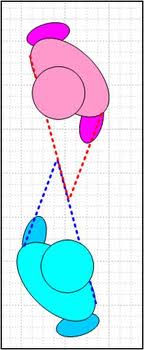
The base level of tactical mechanics is rooted in knowing the “rules of one’s game”; for example, exponents who train for grappling centric venues may develop tactics focused on keeping one’s center of gravity rearward (see Picture 1). Both these grappling players are more difficult to “take down” due to their low centers of gravity, but extremely vulnerable to being struck or flanked by multiple aggressors. Their tactics have the extreme vulnerability to being struck because in the rules of their ‘game’, striking is not allowed; and multiple aggressors do not exist in most gaming venues. Different ‘games’ have different assumptions to them; these assumptions drive the different mechanics that leverage the ‘rules of the game’. The result is the ‘tactics’ of that game.

Picture 1
Assumptions, either explicit or implicit, are the basis of what we term as ‘game training’. Games can have some value; for example, many young people have played the board game Monopoly and learned some rudiments of finance from it. But not all who have learned its winning game strategy have gone on to become financial powerhouses in the ‘real world’. While the game can teach some aspects of wise financial leverage, and even though real money in the real world has some crossover to the game strategy, the removal of assumptions and controls in the real world creates an environment where real money and the game of Monopoly are divergent enough that their strategies of success are not identical.

Understanding that, the importance of knowing what “game” one is preparing for as a student of combatives becomes obvious. Seizan Ryu teaching philosophy states that purpose (the ‘Why’) of one’s training dictates the process (the ‘How’) of one’s training; defining the ‘why’ one trains is critical for increasing the probability of success in application. As a Seizan Ryu practitioner and teacher, the “game” that the system’s tactics are focused on is the “application environment”. The “application environment” in the Seizan Ryu system means any venue devoid of ‘game based rules’. The term “application environment” is used since any ‘non-game application’ occurs in this environment. The “application environment” is devoid of assumptions such as a single unarmed opponent, for example, and its unpredictability eliminates the ability to ‘peak’ one’s training to a specific date. As a result, the tactics have to be applicable across spectrums (environments such as open areas, buildings, homes, etc) and platforms (practitioner’s use of empty hand, edged/impact weapons, firearms, etc) with little to no deviation in mechanics. “Game” training can be used to hone a specific subset of one’s skills or develop a specific type of conditioning; these are force multipliers when combined with sound tactics, however, they are not substitutes for sound tactics. Sound tactics are a result of vetting one’s training in the “application environment”.

The Seizan Ryu Tactically Applied Basics module was developed to expand the awareness of martial arts practitioners regardless of their discipline and provide them with a base level of knowledge with which to vet their current training practices. Most training methods, be it martial arts, defensive tactics, or even firearms courses, have some basic inherent assumptions that allow students to improve technically; however, when not removed, these assumptions prevent growth tactically. This module was the result of attempting to bridge the gap between training methods that focus exclusively on techniques and to provide a format to address students’ needs to becoming tacticians. Bridging this gap is the only reliable method to increase the probability of success in the “application environment”.

As an example for this discussion, I have chosen to address one of the most basic assumptions in most training methods. In order to facilitate repetitive training (ultimately the most efficient way to develop one’s technical skill), the practitioner is pre-positioned in a manner that allows for efficient contact/execution of the technique being taught (see Picture 2). This position, however, is generally not “held” in the “application environment”.

Picture 2
The Seizan Ryu Tactically Applied Basics module addresses the following training gaps:

• In the chaos associated with the fluid dynamics of the “application environment”, the ‘position of familiar execution’ (the relationship that most techniques are initiated from with the threat and defender directly facing each other – Picture 2) is rarely ‘held’ and requires the practitioner to have the ability to recognize or create it. The tactics of recognizing or creating this relationship require the mastery of their own fundamental mechanics.

• Since the urban environment is largely made up of structures, the application environment necessitates that one understand the geometric angles created by structures and the effect of those angles on threat identification, contact, and break-contact tactics. The science of geometric angles is most highly perfected by special operations personnel in the study of CQB (Close Quarter Battle); the extrapolated principles require an understanding of effective range of weapons (be they projectile, edged/impact, or hands/feet), action/reaction related to the OODA loop, and distance-time-angle relationships.

• Strategic advantage is gained through flanking an adversary; few combatives train initiation via flanking since the majority of training consists of defensive maneuvers against straight line attacks (see Picture 2). The result is that most practitioners tend to be less familiar with tactics related to establishing a flanked position initially since they do not get repetitions on the tactic.

What Previous Participants Have Said

• “I found the verbal instruction combined with the demonstrations helpful for someone like myself (completely new to jujutsu) and I did not feel like a complete buffoon in the class.”

• “The concept of repositioning prior to striking and aligning the strike prior to letting the weapon leave the workspace is very powerful. I have extrapolated this into drills I use every day.”

• “It was useful to see how the skills we are learning are applied to a tactical environment. This gives me a better picture of what I can be working towards and with better picture of who this works…it was useful to see how the OODA loop applies.”

• “I enjoyed the 5% offset for the strikes and realize that there is a need to train on it. It is not something I’ve trained on extensively and I think it’s absolutely necessary to master.”

• “The constant attention to ‘aligning’ on the target was most useful. The phrase ‘address the attacker, address the weapon’ was a concise mantra for the training…from a teaching standpoint, reading about the OODA loop was helpful, but seeing it applied throughout the training brought more clarity. As an instructor, it helped me see the shortcomings of in how I teach.”

November 2012 Tactically Applied Basics Flyer